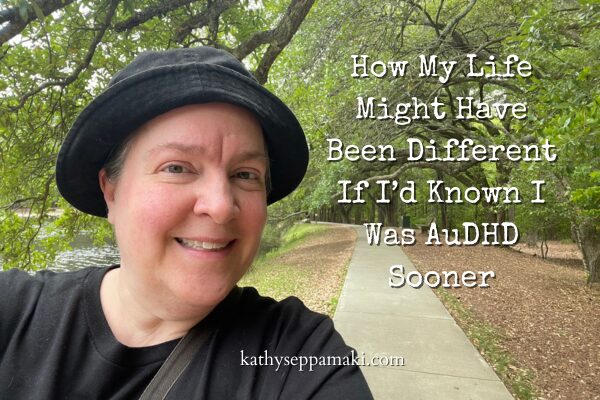
It’s hard to believe that my AuDHD journey started a little over a year ago. But here we are. The past year has been filled with amazing a-ha moments and realizations about my life. And like so many others, it has definitely included grief for who I might’ve been if the autism and ADHD had been uncovered sooner.
For most of my life, I believed there was something fundamentally wrong with me.
I was too sensitive.
Too intense.
Too distracted.
Way too emotional.
Too much… and somehow never enough.
And sadly, I was reminded of this regularly by people in my life. And it made me feel as if I was broken, and I didn’t know how to fix it.
It wasn’t until midlife that I finally received the words that changed everything: AuDHD…autism and ADHD, together in one beautifully complicated nervous system. And once I knew, I couldn’t help but wonder how different my life might have been if I’d known sooner.
I would have stopped trying to fix myself
Growing up, I absorbed the message that my natural way of being needed correction. I learned to mask early, to quiet my intensity, soften my reactions, override my needs, and perform “normal” at all costs.
If I had known I was AuDHD, I wouldn’t have spent decades chasing self-improvement plans designed to turn me into someone else. I wouldn’t have internalized every struggle as a personal failure. I might have understood that my brain wasn’t broken; it was simply wired differently.
And that difference deserved compassion, not correction.
School would have made more sense
School was exhausting in ways I couldn’t articulate. I could hyperfocus on the things I loved and completely shut down when something didn’t engage me. I struggled with organization, deadlines, sensory overload, and social expectations, yet I was often labeled as “not trying hard enough.”
If I had known I was AuDHD, accommodations wouldn’t have felt like weakness. Support wouldn’t have felt like cheating. I might have learned how I learn, instead of forcing myself into systems that were never built for my brain.
I would have trusted my sensitivity
For years, I tried to toughen up. I thought sensitivity was something to overcome rather than honor.
Knowing I was autistic would have helped me understand why noise, chaos, conflict, and emotional intensity hit me so deeply. Knowing I had ADHD would have explained my nervous system’s constant search for stimulation and novelty.
Instead of shaming myself for needing quiet, rest, or recovery time, I might have built a life that actually supported my nervous system…not one that constantly overwhelmed it.
Relationships might have felt safer
I spent so much time trying to be palatable.
I over-explained,
People-pleased.
>I ignored red flags.
And I stayed too long in situations that drained me because I didn’t trust my own perceptions.
If I had known I was AuDHD, I might have understood why social dynamics felt confusing or exhausting. I might have honored my need for deep connection over small talk. And I might have set boundaries earlier, instead of believing discomfort was just something I had to tolerate.
I would have rested without guilt
Burnout has been a recurring theme in my life.
I pushed through exhaustion and overcommitted. I ignored my body’s signals because I thought rest had to be earned. If I slowed down, I felt like I was failing.
Knowing I was AuDHD would have reframed rest as a necessity, not a luxury. I might have recognized burnout for what it was, a nervous system in distress, instead of a character flaw.
I would have found myself sooner
So much of my life was spent searching for answers, trying to figure out why everything felt harder than it seemed for everyone else.
If I had known earlier, I might have met myself with kindness instead of criticism. I might have built a life aligned with who I actually am… creative, intuitive, sensitive, passionate, and deeply thoughtful, instead of who I thought I should be.
Grieving the past, honoring the present
There is grief in discovering this later in life. Grief for the child who didn’t get support. Grief for the years spent masking. And grief for the versions of myself that were misunderstood, even by me.
But there is also relief. And clarity. And finally, permission.
Knowing I am AuDHD didn’t change who I am. It helped me understand who I’ve always been. And now, instead of trying to fix myself, I get to care for myself.
If you’re discovering your neurodivergence later in life too, know this: it’s not too late to build a life that feels safe, supportive, and true to you. You are not behind. You were navigating the world without a map. And you’re still here…
That matters.