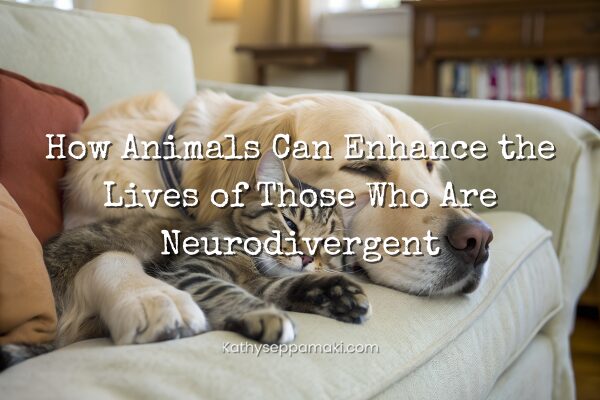
There’s something about animals that just speaks to our nervous systems in a way humans often can’t. Maybe it’s their honesty. Maybe it’s the calm rhythm of their breath. Maybe it’s the fact that they don’t expect us to mask, perform, or explain ourselves. Whatever the reason, many neurodivergent folks find a deep soul-level connection with animals. And as I’ve moved through midlife, I’ve noticed how essential that connection truly is.
When you’re neurodivergent, the world can feel loud, unpredictable, and emotionally high-maintenance. Animals, on the other hand, offer a kind of steady, uncomplicated companionship that hits like a warm cup of tea on a day when your brain is doing cartwheels.
Here are a few ways our furry (and feathery and scaly) friends enrich our lives.
Animals create predictable, comforting routines
A lot of neurodivergent people thrive on routines. Not rigid schedules, but gentle rhythms that make the world feel less chaotic. Animals naturally create that. Morning feedings. Afternoon walks. The nightly cuddle that happens on the same side of the couch every single time because animals are, let’s be honest, just as routine-driven as we are.
These little anchor points give the day shape, even when executive function is hiding under a blanket somewhere.
They help regulate our nervous systems
There is nothing quite like the weight of a purring cat or the soft nuzzle of a dog who can sense your anxiety before you’re even aware of it. Many neurodivergent people experience heightened sensitivity…emotionally, physically, energetically. Animals match that sensitivity with a presence that is grounding.
Deep pressure from a large dog leaning into you. The texture of fur under your fingers. The low rumble of a happy pet. These aren’t small comforts; they’re sensory regulation in its purest form.
They offer connection without social demands
Midlife can be wild for neurodivergent folks, especially if you’re unmasking, healing, or finally understanding diagnoses that arrive decades later. There’s grief sometimes. There’s relief. There’s the tender question: “Who am I without all the performance?”
Animals don’t require performance. They don’t care if you’re awkward or chatty or quiet or stimming or in need of solitude. They let you just…be. That kind of unconditional acceptance can feel downright holy.
They keep us present (in the best ways)
Neurodivergent brains love to time-travel, into the past, into the future, into every hypothetical branch on the decision tree. Animals bring us back to the moment. A dog who wants you to throw a ball now. A cat who hops onto your keyboard because the present moment should obviously be about them. A bird whose entire joy is singing just because it’s morning.
Their presence reminds us that “right now” exists, and it’s worth noticing.
They open us to joy and whimsy
This one is especially lovely in midlife, when we’re reclaiming parts of ourselves we tucked away for far too long. Animals make us laugh. They help us soften. They remind us that play is not just for children. If you’ve ever watched a cat do zoomies at 3 am or a dog prance proudly with a stick twice its size, you know exactly what I mean.
Animals invite us into the kind of whimsy neurodivergent folks often crave but don’t always feel permission to embrace.
They support emotional healing
There’s a reason so many therapists have therapy animals or recommend emotional support companions. Animals are intuitive. They sit with us in sadness, celebrate with us in joy, and offer silence when words feel impossible. For those who grew up misunderstood or mislabeled, the simple bond with an animal can feel like the first taste of true, uncomplicated love.
In midlife, this connection becomes even more powerful
As we shed old identities and build lives that actually fit our neurodivergent selves, animals can become companions on that journey — grounding us, soothing us, and reminding us we’re allowed to move at our own pace.
Some of us rediscover our love for animals in midlife. Some adopt pets for the first time. Some volunteer at shelters, feed the birds, or talk to squirrels (no judgment, they’re great listeners). No matter the form it takes, the bond is real and deeply nourishing.
If you’re neurodivergent and navigating the wild landscape of midlife, you don’t have to do it alone. A soft paw, a warm body, a gentle presence…sometimes that’s exactly the kind of support our hearts understand best.