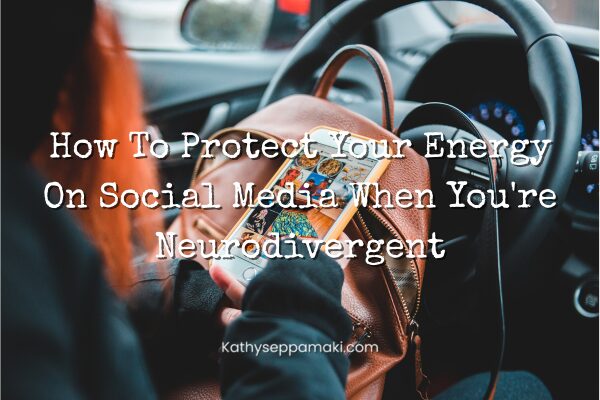
Social media can be a lifeline for neurodivergent people. It’s where we find language for our experiences, discover we’re not broken, and finally feel seen. It can also be a place of connection, creativity, humor, and shared joy.
And…it can absolutely drain the life out of us.
If you’re neurodivergent, you’re likely more sensitive to sensory input, emotional undercurrents, injustice, tone, and unspoken expectations. Social media is basically a nonstop firehose of all of that. Protecting your energy online isn’t about being fragile or avoiding the world. It’s about honoring how your nervous system actually works.
Here’s how to stay connected without burning yourself out
First, understand that social media is an energetic environment, not just a digital one. Even though it lives on a screen, social media is full of emotional charge. Trauma stories, outrage cycles, performative kindness, comparison traps, parasocial relationships, and constant urgency all carry energetic weight. Neurodivergent brains often process this more deeply and less selectively. If you feel exhausted, dysregulated, or oddly emotional after scrolling, that’s not a personal failure. It’s your system saying, “That was a lot.”
Curate your feed like it’s sacred space
You are allowed to unfollow, mute, block, and filter without explanation or guilt. If someone consistently makes you feel tense, ashamed, behind, angry, or activated, even if they’re “doing good work,” they don’t get automatic access to your attention. Follow accounts that feel grounding, spacious, honest, playful, or gently inspiring. Your nervous system does not benefit from constant exposure to crisis, even if the crisis is real.
Stop mistaking visibility for obligation
Many neurodivergent people feel pressure to watch every story, read every post, respond thoughtfully, and stay informed at all times. That sense of duty can come from justice sensitivity, people-pleasing, or fear of rejection. You are not required to consume everything just because it’s there. Missing content does not make you uncaring, ignorant, or irresponsible. It makes you regulated.
Set energetic boundaries, not just time limits
Time limits help, but energy boundaries go deeper. Before you open an app, ask yourself: “What am I here for right now?” Connection? Inspiration? Sharing something? If you notice yourself doom-scrolling, comparison spiraling, or absorbing emotions that aren’t yours, that’s your cue to step away, even if your timer hasn’t gone off yet. Trust your body’s signals over productivity rules.
Be mindful of over-attachment
Neurodivergent people can form intense connections through shared experience and vulnerability, especially online. While this can be beautiful, it can also lead to emotional over-investment in people who don’t actually know you. If someone’s mood, approval, or content starts affecting your self-worth or emotional stability, it’s worth pulling back. Real connection should feel nourishing, not consuming.
Release the pressure to perform your identity
You do not owe anyone perfect language, constant advocacy, or public processing of your neurodivergence. Social media often rewards oversharing and “relatable” pain, which can quietly encourage self-extraction. You are allowed to be private, inconsistent, quiet, or still figuring things out. Your worth is not measured by how articulately you explain yourself online.
Create intentional exit rituals
Because neurodivergent brains can struggle with transitions, abruptly closing an app can leave emotional residue. Try simple closing rituals: take three deep breaths, stretch your hands, look around the room, or name five physical objects near you. This helps your nervous system understand that you’ve left the energetic space and returned to your own body.
Remember that rest is not disengagement
Stepping back from social media does not mean you’ve failed, disappeared, or lost relevance. Many neurodivergent people need cyclical engagement. Periods of connection followed by periods of quiet integration. That rhythm is healthy. You’re not meant to be “on” all the time.
Social media can be a tool, a mirror, a playground, or a minefield…sometimes all in the same day. Protecting your energy isn’t about building walls. It’s about building discernment, self-trust, and compassion for the way your nervous system navigates the world.
You are allowed to log off. You are allowed to choose yourself, even online.